
Last updated: November 16, 2026
Frameless shower glass repair usually starts with the smallest fix that still solves the problem: chip repair, seal replacement, or hardware replacement. In many cases, a 3/8-inch panel can be fixed without full replacement, but a crack through the glass or damage at the mounting point usually ends the repair option. If the pane is cracked through, loose at the anchors, or warped by bad fit, repair stops being practical and panel replacement becomes the safer choice.
Key takeaways
Frameless shower glass repair usually falls into four practical choices: chip repair, seal replacement, hardware replacement, or panel replacement.
- Small chips, worn seals, and tired hinges are often fixable without replacing the whole enclosure.
- The first check is damage type: cosmetic marks, hardware wear, or structural breakage.
- A repair that leaves movement, leaks, or stress at the anchors is not a real fix.
- Panel replacement makes more sense when the damage reaches the edge, corner, or mounting points.
- A good contractor should explain the trade-off between a quick cosmetic fix and a longer-lasting repair.
What does frameless shower glass repair cover?
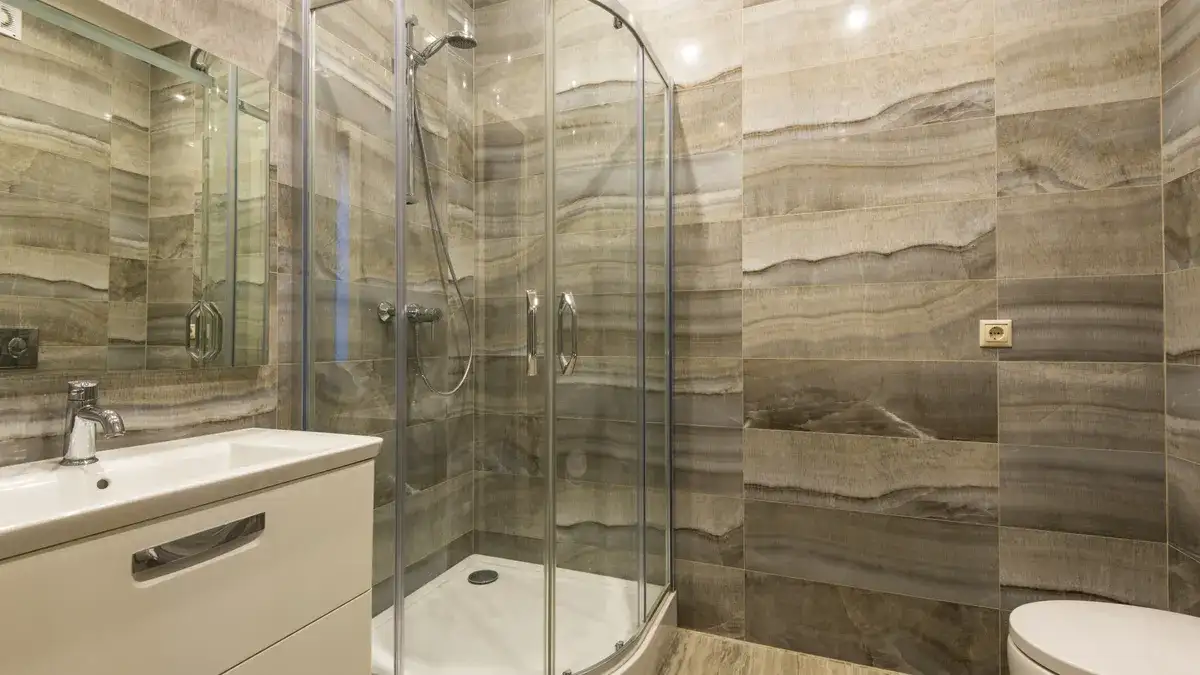
Frameless shower glass repair covers three different jobs: fixing the damage on the pane, replacing worn parts, and changing out a full panel when the pane itself is the problem. A chip in the middle of a 3/8-inch panel is not the same job as a sagging hinge, and a torn sweep is not the same as a cracked door.
For example, chip repair can reduce the look and spread of a small impact mark. Seal replacement can stop water from escaping at the edge. Hardware replacement can bring the door back into alignment when hinges, clips, or brackets have loosened.
A generic article often groups all of this under “glass repair,” which hides the real decision. That is where people waste time and money. A chip repair is usually a cosmetic or containment fix. A seal or sweep fix is a water-control fix. A hardware swap is a movement fix. A full panel replacement is the answer when the pane has lost integrity.
Because frameless enclosures depend on fit, the difference matters. A panel that is off by even a few millimeters can rub, bind, or leave a gap that no new seal can hide. That is why the question is not just “Can it be repaired?” It is “Which part failed, and what else did it damage?”
For broader context, see the related frameless shower glass installation and fit page and the shower door hardware replacement guide.
Can frameless shower glass be repaired?
Yes, frameless shower glass can often be repaired when the damage is limited to a chip, a seal, a hinge, a clip, or a door sweep. The repair is usually realistic when the pane is still flat, the edges are intact, and the door or panel is not under visible stress.
A practical way to sort the problem is to work from the smallest fix to the largest:
-
Check the chip or mark first.
A small chip away from the edge may be a repair candidate. If the damage is at the corner or runs toward the edge, the pane is more likely to need replacement. The result you want here is simple: the damage stays stable and does not grow after regular use. -
Inspect the seals and sweeps.
Look for hardened rubber, gaps at the bottom edge, torn sweeps, or a seal that has pulled away by a few millimeters. These parts are often the easiest repair because they are wear items, not structural parts. A correct fix should stop drips without forcing the door to drag. -
Check the hinges and clips.
Loose hardware can make the door drop, rub, or fail to close squarely. Sometimes the answer is tightening, but worn hinge parts or bent clips need replacement. A door that closes with a clean, even gap is the result to look for. -
Test the panel for movement.
If the pane shifts in its setting, flexes at the anchor, or shows stress at a drilled hole, the problem is beyond a patch job. At that point, the repair is likely to be a larger hardware change or a new panel. -
Decide if the fix is cosmetic or structural.
Cosmetic repair can improve appearance and stop minor spread. Structural repair has to restore support and alignment. If the issue is structural, cosmetic work alone is not enough.
A repair is not the right choice when the glass has a crack that reaches the edge, when the hole around a hinge is damaged, or when the panel no longer sits square. Those cases can look minor from a distance but fail under daily use. A person asking for a cheap fix in that situation is usually buying a short delay, not a solution.
For deeper guidance on fit and alignment, this page sits under the broader frameless shower glass installation and fit hub.
Which repair option fits the problem?
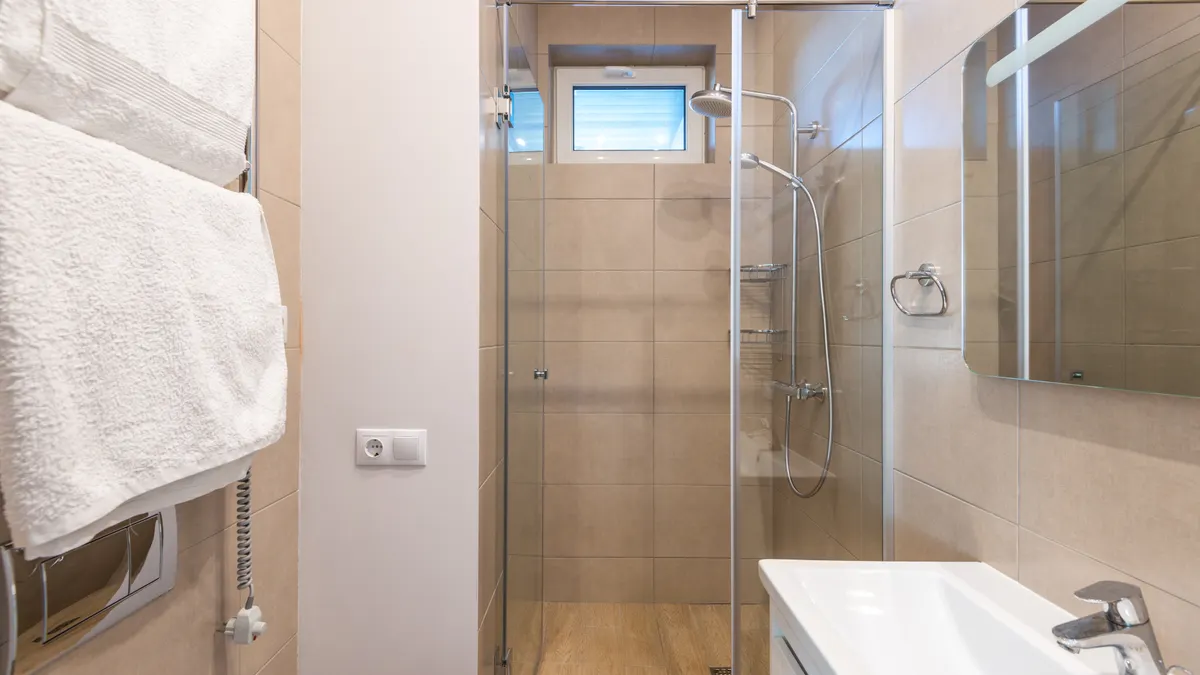
The right option depends on what failed first, how far the damage has spread, and whether the enclosure is still aligned. A chip repair does one job, seal replacement does another, and hardware replacement solves a different set of problems again.
| Problem | Likely repair option | What it fixes | When it is not enough |
|---|---|---|---|
| Small chip in the body of the pane | Chip repair | Appearance and limited spread | Chip reaches the edge or corner |
| Water leaking at the bottom | Seal or door sweep replacement | Gap control and splash control | Door is out of square or drags |
| Door sags or closes crooked | Hinge, clip, or bracket replacement | Alignment and support | Drilled hole or mounting point is damaged |
| Panel shifts or feels loose | Hardware replacement, then reset | Stability | Frame-free mounting points are compromised |
| Crack through the pane | Panel replacement | Safety and structure | Never a true repair candidate |
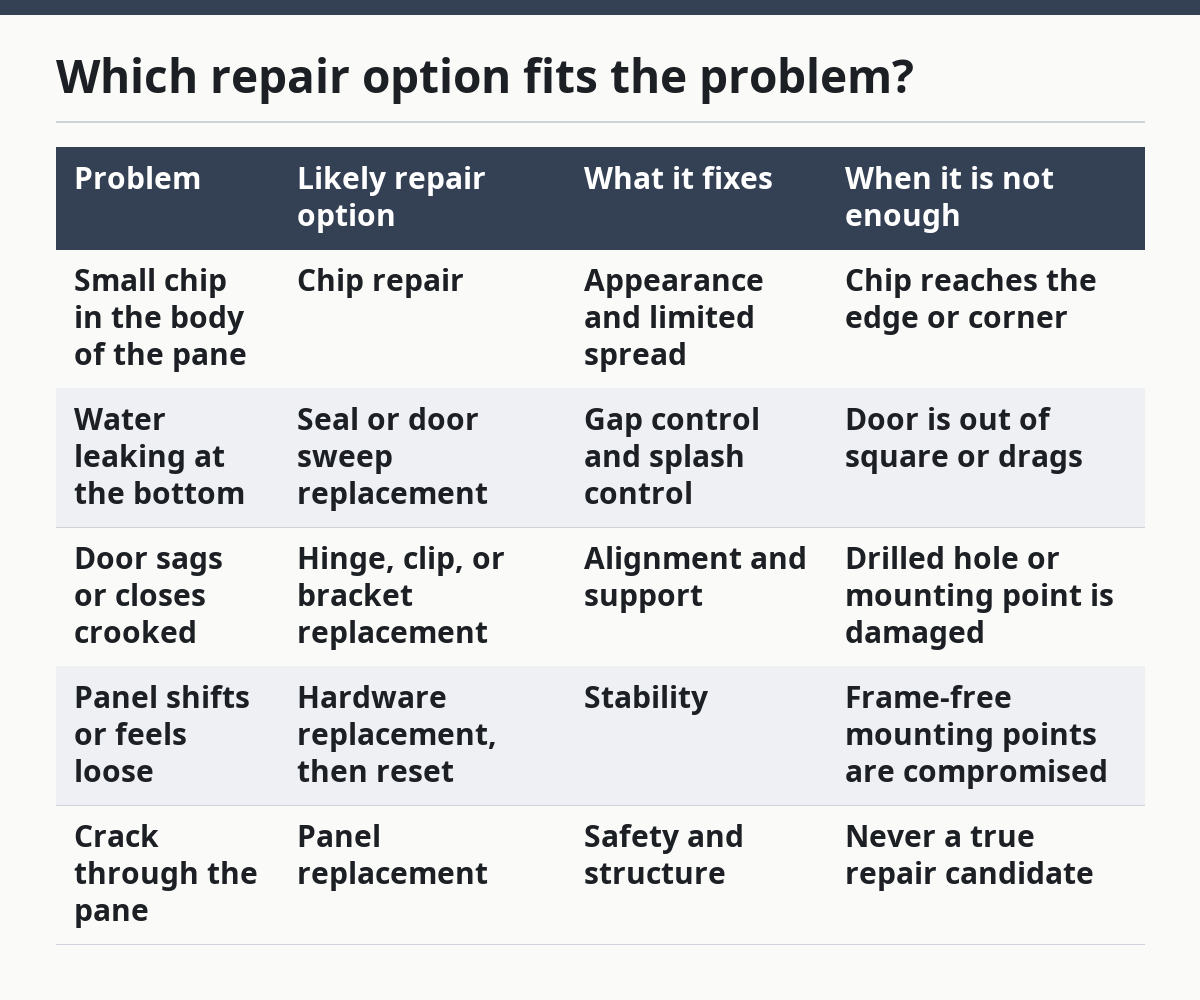
This table shows the main trade-off. The lower-cost fix is usually the smallest one that restores function. The wrong fix is the one that hides a bigger failure. A new sweep will not save a sagging door. A hinge swap will not repair a cracked pane. A chip repair will not make a split edge safe.
The cost question sits behind all of this, even when no exact quote is possible. Chip repair is usually the lightest job. Hardware work is usually more involved because the door has to be supported, removed, or re-set. Panel replacement is the largest job because the glass must be measured, ordered, handled, and installed again. The final price depends on panel size, thickness, access, and whether the enclosure needs more than one part replaced.
What does chip repair really do?
Chip repair mainly stabilizes a small flaw and improves the look of the pane, but it does not turn damaged glass into new glass. A clean repair can make a chip far less visible and help keep the edge from spreading farther under use.
Specifically, this option makes the most sense when the chip is small, isolated, and not at a critical point. A chip in the center of a panel is much more likely to be a repair candidate than a chip that sits on a drilled hole, at a corner, or on the edge where the load concentrates. Those edge and corner points carry more stress, and that is where small damage becomes a larger problem.
A good chip repair should leave the pane stable, not rough, and not under added tension. If the damage has sharp radiating lines, if the glass sounds loose around the impact point, or if the chip has already opened into a crack, the repair window is closing fast. At that stage, the honest answer is usually replacement.
Chip repair is wrong for someone who wants the pane to look perfect again from every angle. It can improve appearance, but it may not disappear completely. It is also not the right answer when the chip is part of a larger fit issue, because a pane that is under stress will keep creating new damage.
What should be replaced instead of repaired?
A panel should be replaced instead of repaired when the damage reaches the edge, the hole, or the mounting point, or when the pane has a crack that runs through the body of the glass. Those are structural failures, not surface problems.
In that situation, many people try to save money and end up paying twice. If a 3/8-inch panel has a crack near a hinge cutout, the door may keep shifting even after the hardware is tightened. If a crack extends to the edge, the pane can keep opening under normal closing force. If the mounting hole is damaged, the panel may no longer carry the load safely.
Replacement also makes sense when the damage is small but the whole panel has drifted out of fit. A frameless enclosure relies on exact spacing. If a panel has to be forced into place, shimmed heavily, or held by tired clips and old seals, the real fix may be a new piece cut to the correct size.
The honest downside of replacement is time. It usually takes longer than a part swap because the new pane has to match the opening, the hardware has to line up, and the final fit has to be checked again. The upside is that the result is not a patch over a failing panel. It is a reset.
What should a contractor check before starting?
A contractor should check the pane thickness, the location of the damage, the condition of the hinges, and the state of the seals before choosing a repair path. Those four checks decide whether the job is small, moderate, or a full replacement.
The most useful questions are plain ones:
- Is the damage a chip, a crack, or both?
- Is the flaw in the middle, at the edge, or at a hole?
- Are the hinges, clips, and brackets tight and square?
- Are the seals, sweeps, or gaskets still flexible?
- Does the door close without rubbing?
Those questions matter because frameless enclosures fail in layers. Water leakage can point to a seal issue, but it can also mean the door is out of plumb. A loose hinge can create a drip path that looks like a bad sweep. A chip can be harmless, or it can be the first sign of a bigger stress pattern.
A careful assessment also keeps the repair from overreaching. A full panel replacement is not needed for every flaw, and a seal swap is not enough for every leak. The right contractor should explain why one option is enough and another is not. If the answer stays vague, or if every problem gets the same fix, that is a warning sign.
For damage like this, the practical standard is simple: the repair should solve the cause, not just cover the symptom. That approach is also where the broader frameless shower glass installation and fit guidance on this site connects back in. For safety and handling standards, see the National Glass Association and ASTM International resources.
FAQ
Can frameless shower glass be repaired?
Yes, frameless shower glass can often be repaired when the damage is limited to a chip, a worn seal, a loose hinge, or a failed sweep. The repair is less likely to be enough when the pane is cracked through, loose at the mounting point, or bent out of alignment.
When should a panel be replaced instead of repaired?
A panel should be replaced instead of repaired when the damage reaches the edge, corner, drilled hole, or hinge area. It also should be replaced if the crack runs through the pane or the panel no longer sits square in the opening.
Can hardware be replaced without redoing the whole enclosure?
Yes, hardware can often be replaced without redoing the whole enclosure. Hinges, clips, brackets, seals, and door sweeps are separate parts in many frameless setups, so one failed part can usually be changed on its own. The catch is that a bad fit or damaged mounting point can turn a small hardware job into a larger repair.
Drafted with AI; not yet reviewed by a person.