Cracked or Chipped Shower Door Glass: Repair or Replace?

A cracked or chipped tempered shower door panel should be replaced, not repaired — the glass itself can’t be safely patched, filled, or re-drilled once it’s cracked or chipped. Tempered glass is heat-treated so that it can’t be cut, drilled, or ground after that treatment, and a panel that’s already cracked or chipped can fail suddenly and completely without warning. Problems with the hardware, hinges, or seals are a different story — those are often genuinely repairable without touching the glass at all.
- Key takeaways
- Any crack, chip, or “star” break in the glass itself means replacement, not repair — this applies to tempered shower glass specifically.
- Tempered glass is defined by a federal safety standard as glass that “cannot be cut, drilled, ground, or polished after treatment,” which is the technical reason a cracked panel can’t be patched.
- When tempered glass does fail, it’s designed to break into small, less sharp pieces rather than large shards — which is also why a compromised panel is a real safety risk, not just a cosmetic one.
- Hardware problems (loose hinges, a worn seal, a misaligned door) are usually repairable and don’t require replacing the glass.
- Replacement of a cracked or chipped panel is a job for a licensed glass installer, not a DIY project.
Why can’t cracked or chipped tempered glass be repaired?
The answer comes down to how tempered glass is made. Under the U.S. Consumer Product Safety Commission’s federal safety standard for architectural glazing materials (16 CFR Part 1201), tempered glass is defined as glass that has been “specially heat treated or chemically treated” so that it cannot be cut, drilled, ground, or polished after treatment. That treatment is what gives the glass its strength and its safety behavior — but it also means any attempt to patch, re-drill a new hinge hole in, or grind down a cracked or chipped panel after the fact can’t restore it, and can make it fail.
The related voluntary standard, ANSI Z97.1 (the consensus standard that 16 CFR 1201 and most building codes reference), requires tempered glass to pass an impact test and a “center punch fragmentation” test: when deliberately broken, the glass has to break into small, relatively dull pieces rather than large sharp shards — specifically, the 10 largest crack-free fragments can’t weigh more than the equivalent of 10 square inches of the original glass. That fragmentation behavior is exactly why building codes require tempered (or laminated) safety glass in shower and tub enclosures in the first place. It’s also why a cracked or chipped panel is a real hazard, not just an eyesore: once the glass’s internal stress pattern is disturbed by a crack or deep chip, it can let go suddenly, with no warning crack that slowly spreads the way ordinary window glass might.
Check your local building code for the specific glazing requirements that apply where you live — 16 CFR 1201 is the federal baseline, and it doesn’t replace a local permit or code check for your particular job.
Is it ever safe to DIY a glass repair?
No, not for the glass itself. There’s no epoxy, resin, or clear filler that restores a tempered panel’s strength once it’s cracked or chipped — you’d be gluing cosmetic damage over glass that is still structurally compromised and still liable to fail suddenly. Anything that involves the glass surface or edge — filling a chip, “fixing” a crack, drilling a new hole for different hardware — isn’t a safe DIY job and isn’t something a glass shop can safely do to your existing panel either. The panel has to be replaced with a new piece of tempered (or laminated) glass, cut and tempered to the openings and hardware your installer specifies.
What about a light surface scratch?
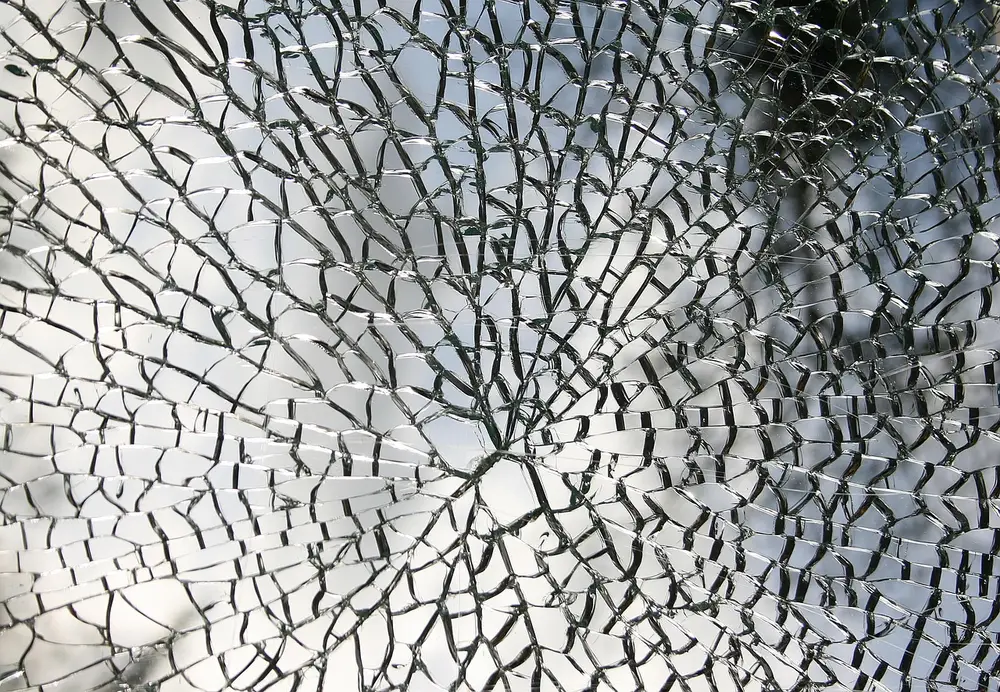
A scratch is a different situation from a crack or chip, and it’s worth telling apart. A shallow, cosmetic scratch that doesn’t catch a fingernail and hasn’t gone through the surface of the glass can sometimes be polished down by a glass professional using fine abrasive and polishing compounds, similar in principle to how professional restoration removes hard-water etching (see our guide on removing hard water stains). But any scratch deep enough to catch a fingernail, any crack no matter how small, and any chip at an edge or corner should all be treated the same way as the damage above: as a reason to replace the panel, not polish it.
How do you tell if it’s the glass or the hardware?
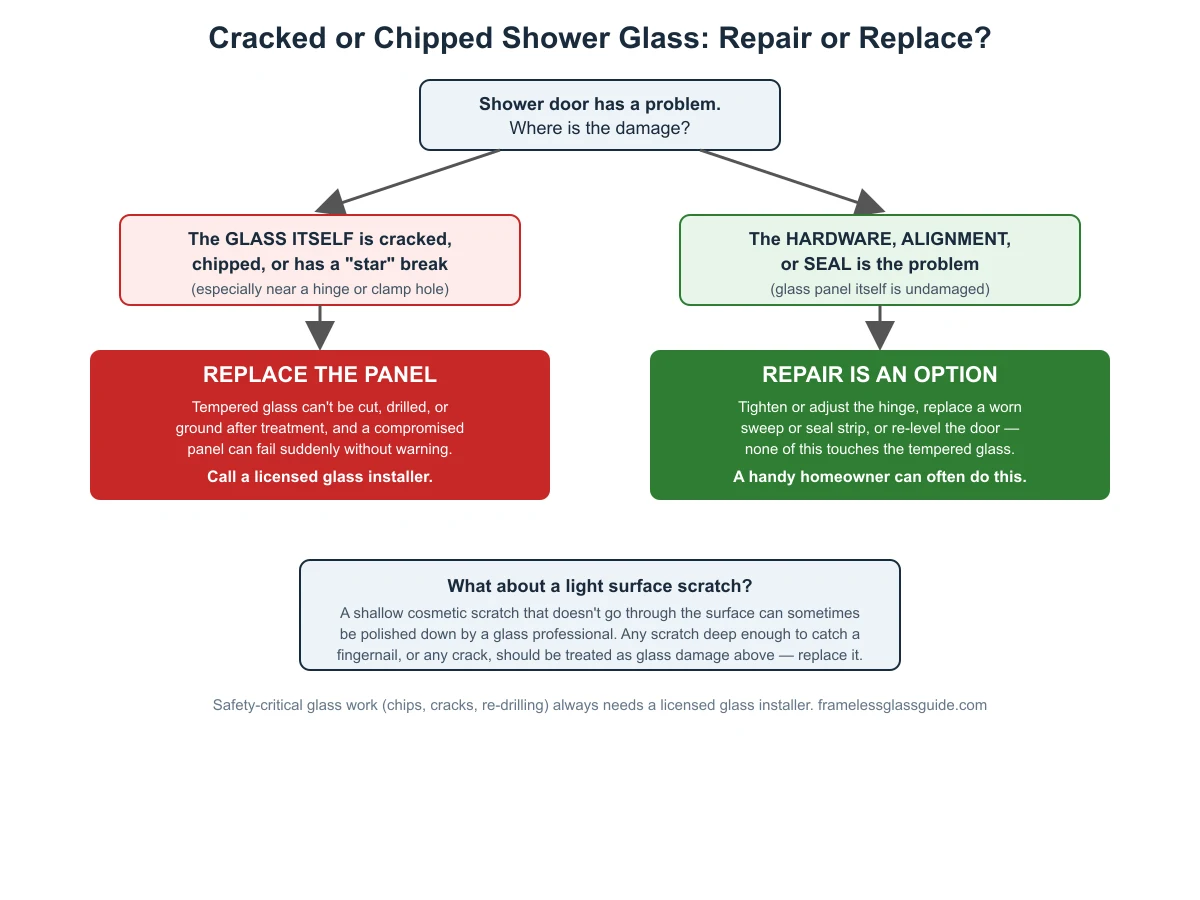
Look at where the actual damage is. If the glass panel itself has a crack, a chip, or a “star” break (a small impact point with cracks radiating outward) — especially anywhere near a hinge or clamp hole, where stress concentrates — that’s glass damage and it means replacement. If the panel is intact and the problem is a door that won’t close right, a hinge that’s loose, a gap that’s grown uneven (see our guide to bottom-gap tolerance), or a seal that’s worn out, that’s a hardware or alignment issue and is usually a genuine repair.
| What’s damaged | Repair or replace? | Why |
|---|---|---|
| Crack anywhere in the glass | Replace the panel | Tempered glass can’t be re-fused; a cracked panel can fail suddenly |
| Chip or “star” break, especially near a hinge hole | Replace the panel | Stress concentrates at edges and holes; damage there is a common failure starting point |
| Deep scratch (catches a fingernail) | Replace the panel | Treated the same as a chip — the surface is structurally compromised |
| Shallow cosmetic scratch, not through the surface | Sometimes repairable | A glass professional may be able to polish it down without affecting strength |
| Loose or worn hinge, misaligned door | Repair | Hardware issue only — doesn’t touch the glass itself |
| Worn sweep, seal, or gasket | Repair | Replaceable part, not a structural issue |
What does replacement involve?
A licensed glass installer measures the opening and the existing hardware, orders a new piece of tempered (or laminated, depending on your enclosure) glass cut and drilled to match, and installs it using your existing hinges and hardware where that hardware is still sound. Panel glass thickness matters here too — our guide to 3/8″ vs. 1/2″ glass explains why the replacement has to match your original thickness, since hardware is rated for a specific glass weight and width. Because tempered glass can’t be trimmed or adjusted after the fact, any measurement mistake means the new piece has to be scrapped and re-ordered — which is a large part of why this is a job for a professional rather than an improvised fix.
On cost: there’s no independently verified national price range we can point to for this specific repair-vs-replace situation, so we won’t quote one here — get a quote from a local licensed glass installer, since price depends on your glass thickness, panel size, and whether any hardware needs replacing along with the glass. If you’re weighing a full replacement against starting over with a different setup, our frameless shower door guide covers thickness, hardware and cost basics in one place.

Frequently asked questions
Can I use clear epoxy or resin to fill a crack myself?
No. Epoxy or resin can hide a crack cosmetically but does nothing to restore the glass’s original tempered strength, and the panel remains at risk of sudden failure. Stop using the door and have the panel replaced by a licensed glass installer rather than attempting a cosmetic fix.
Is a small chip near the edge actually dangerous?
Yes, more than a chip in the middle of the panel would be. Edges and corners, and especially existing hinge or clamp holes, are where stress concentrates in tempered glass, so damage in those spots is a common starting point for a sudden, larger failure. Treat any edge chip as a reason to replace the panel.
How much does it cost to replace shower door glass?
We don’t have an independently verified national price range to give you — cost depends heavily on glass thickness, panel size, and whether hinges or other hardware need replacing too. Get a quote from a local licensed glass installer rather than relying on a single company’s advertised price as a national figure.
Do I need to replace the whole enclosure, or just the cracked panel?
Usually just the damaged panel. Fixed and operable (hinged or sliding) panels are typically separate pieces of glass, so a glass installer can often replace only the cracked or chipped piece and reuse the existing hardware and remaining panels, as long as that hardware is in good condition.
Is it safe to keep using the door if the glass is only chipped, not fully cracked?
No — stop using it until it’s replaced. A chip in tempered glass is still damage to a heat-treated surface that’s designed to hold stress in a specific pattern; a chip can be the starting point for a sudden, larger failure even if the panel still looks mostly intact. Close off or tape over the area and arrange a replacement rather than continuing to use a chipped panel.
Sources
- U.S. CPSC, 16 CFR Part 1201 — Safety Standard for Architectural Glazing Materials
- ANSI Z97.1 overview — Intertek
framelessglassguide.com Editorial Team. Last updated: November 13, 2026.


[…] by a glass professional; a deeper scratch or chip is a different problem — see our guide on whether cracked or chipped shower glass should be repaired or replaced for when a damaged panel needs to come out rather than be […]
[…] scratch may improve after 1 careful polishing attempt; deep grooves usually do not disappear. Light surface marks may improve with the right polishing compound and a microfiber cloth, but deeper scratches in […]