
A frameless shower door leaking at the bottom almost always comes from one of three sources: a worn or wrong-size door sweep, a threshold or curb that slopes the wrong way, or a gap that’s simply wider than it should be. Fix the sweep and the slope before you ever reach for a caulk gun — caulking the moving gap under the door is a documented sealing mistake that can glue the door shut.
Key takeaways
- Trace the leak by exactly where the water shows up: a straight line at the very bottom edge, water running out along a sloped floor, or a drip at a fixed side joint each point to a different cause.
- A frameless enclosure is not sealed like an aquarium — by design, performance depends on sweep, slope and glass position working together, not on sealant alone.
- Sealant-manufacturer guidance is specific: caulk belongs at fixed joints, never across a moving joint, a sliding track, or a drainage path.
- The bottom gap under a swinging or sliding door is a moving joint. Filling it with silicone can bond the door to the floor or track so it won’t open.
- If the sweep and slope both check out and the leak continues, the glass itself may be out of plumb and need a professional reset, not more sealant.
Why isn’t a frameless shower door sealed like a fish tank?
It’s a fair question, because the glass looks solid. But a frameless enclosure is built to shed water, not hold it in like an aquarium. Glass Magazine, the National Glass Association’s trade publication, makes this point directly: a frameless shower is not an aquarium, and how well it keeps water inside depends on the full configuration — glass position, hardware and threshold together — not on the glass itself being watertight.
That framing matters here because it explains why a leak at the bottom is rarely a sign of a defective panel. It’s almost always one part of that system — the sweep, the slope, or the fit — not working with the others.
How do you trace a bottom leak to its real cause?
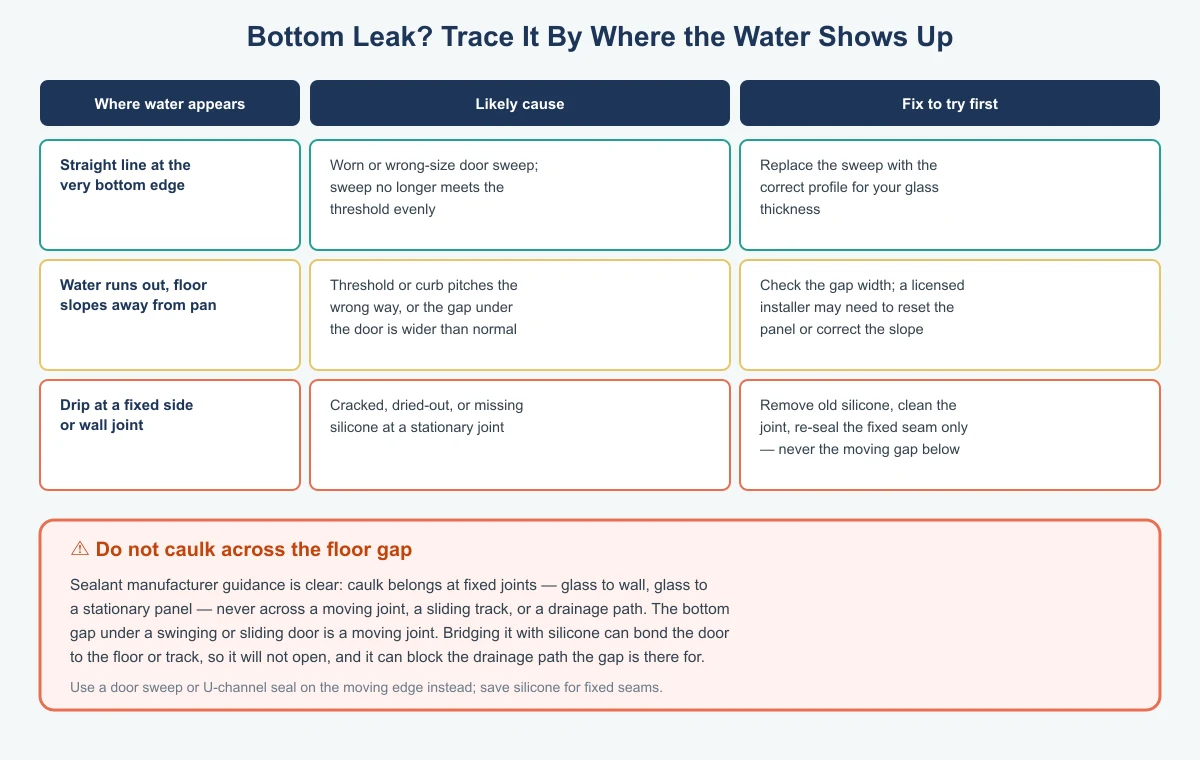
Where the water actually shows up tells you where to look first. Match your pattern to the table below before you touch anything.
| Where water appears | Likely cause | Fix to try first |
|---|---|---|
| A straight line right along the bottom edge | Worn or wrong-size door sweep that no longer meets the threshold evenly | Replace the sweep with the correct profile for your glass thickness |
| Water runs out and the floor nearby slopes away from the pan | Threshold or curb pitched the wrong way, or a wider-than-normal bottom gap | Check the gap width (see our gap-tolerance guide); a licensed installer may need to correct the slope or reset the panel |
| A drip at a fixed side or wall joint, not the moving door | Cracked, dried-out or missing silicone at a stationary joint | Remove the old silicone, clean the joint, and re-seal only the fixed seam — never the moving gap below |
Start with the bottom edge if that’s where the water is actually appearing. If the sweep looks intact and the floor is level but the leak persists, the door or panel may be out of plumb — that’s a fit problem a glass contractor needs to look at, not something another sweep or bead of caulk will solve.
Why should you never caulk across the gap at the bottom?
This is the mistake that turns a simple fix into a bigger repair. GE Sealants’ own installation guidance for sealing a shower door is direct on this point: do not seal moving joints, sliding tracks that need to function, or built-in drainage paths that help water escape. Apply silicone only where the glass or frame meets a fixed surface — a wall, a curb, or a stationary panel connection.
A door sweep is designed for the moving edge, specifically the bottom, where it has to control water while still letting the door open and close freely. Silicone sealant is designed for the opposite job: a fixed joint between two surfaces that don’t move relative to each other. The bottom gap under a hinged or sliding door is a moving joint by definition — the door has to clear it every time it opens.
Bridging that gap with a bead of silicone doesn’t just risk looking messy. Because silicone cures into a solid, flexible-but-bonded seal, caulking across a joint that’s supposed to move can bond the door to the floor, the track, or an adjacent panel, so it no longer opens the way it should. If the gap genuinely needs to be smaller, the fix is a correctly sized sweep or a reset of the panel position — not sealant standing in for a part that was designed to do that job.
What if the sweep and slope both check out?
If you’ve replaced the sweep, confirmed the threshold slopes correctly toward the drain, and the leak is still showing up at the bottom edge, the glass panel itself may be out of plumb or set at the wrong height. That’s a mechanical fit issue, not a sealing issue, and it’s worth bringing in a licensed glass installer rather than trying another DIY pass. For background on how hinged versus sliding hardware handles the bottom edge differently in the first place, see our comparison of hinges versus sliding track systems.
It’s also worth ruling out spray pattern before assuming the hardware is at fault: a shower head aimed directly at the door seam can force water past a perfectly good sweep simply through water pressure and angle. Try redirecting the spray away from the door for one shower and see whether the leak changes.
How much gap at the bottom is actually normal?
Some gap under a frameless door is normal and by design — it’s not something you can or should seal shut. How much is normal, and when a gap has gotten wide enough to be a real problem, is its own question with enough nuance to deserve a full answer; see our dedicated guide to gap tolerance at the bottom of a frameless door for a measuring approach and what counts as too wide.
FAQ
Can I use silicone caulk to fix a leaking shower door at the bottom?
Only at fixed joints — where the glass meets a wall or a stationary panel. Sealant-manufacturer guidance warns against sealing moving joints, sliding tracks or drainage paths, and the bottom gap under a door that swings or slides is a moving joint. Caulking across it risks bonding the door shut instead of fixing the leak.
Is a leaking frameless shower door always a sign something was installed wrong?
Not necessarily. Door sweeps wear out over time even on a correctly installed enclosure, and thresholds can settle slightly as a house ages. A frameless shower is also not designed to be fully watertight the way a sealed tank is — it depends on sweep, slope and glass position working together, so normal wear in any one part can start a leak.
Why does my shower only leak at the bottom and nowhere else?
The bottom edge is where the door sweep, the threshold, and the floor slope all have to work together, and it’s also where standing water has the most contact time. That combination makes it the most common failure point, even when the rest of the enclosure is sealed correctly.
Should I call a glass installer or try a DIY fix first?
A worn sweep is a reasonable DIY replacement. If the threshold slope is wrong, the glass is out of plumb, or you’ve already tried a new sweep without success, that’s a fit problem better handled by a licensed glass installer than by more sealant.
Sources
- Glass Magazine (National Glass Association) — Safe + Beautiful + Frameless
- GE Sealants — Bathroom Waterproofing: How to Seal a Shower Door
By framelessglassguide.com Editorial Team. Last updated: November 13, 2026.

[…] Frameless Shower Door Leaking at the Bottom […]