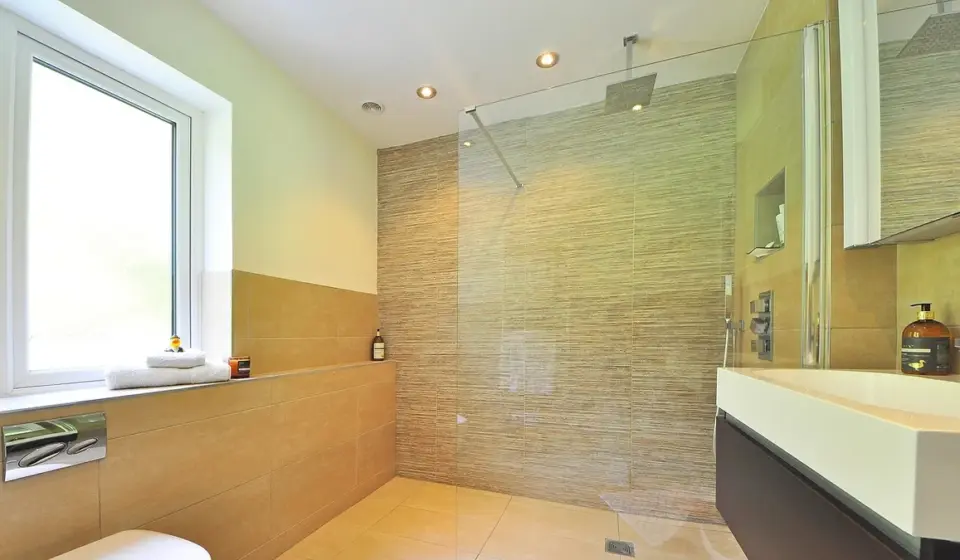

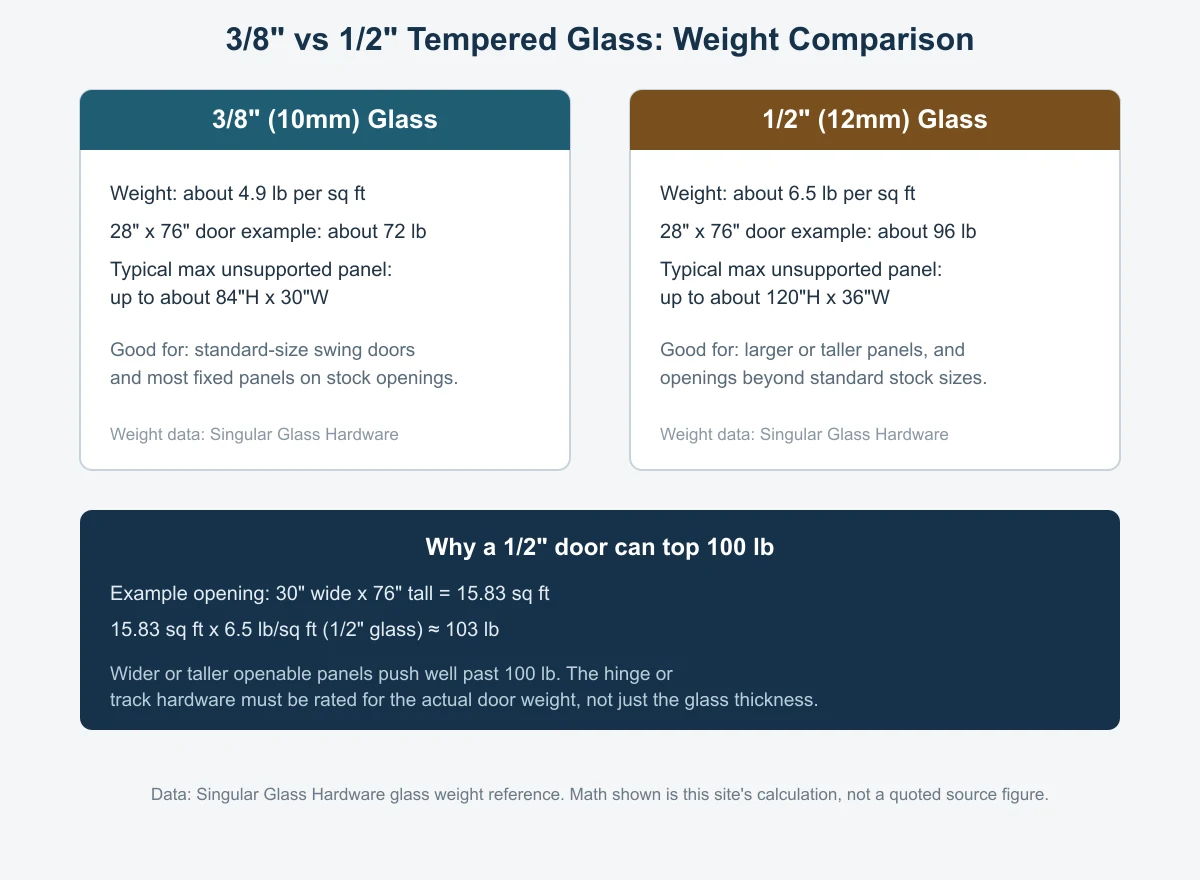
3/8″ (10mm) tempered glass is the standard choice for most frameless shower panels up to about 84″ tall by 30″ wide. Larger or taller panels need 1/2″ (12mm) glass for the same rigidity. The extra thickness also means extra weight — about 6.5 lb per square foot versus 4.9 lb per square foot — which is why a 1/2″ door can top 100 pounds and needs hardware rated for that exact weight.
Key takeaways
- 3/8″ suits most standard swing doors and fixed panels on stock-size openings.
- 1/2″ is needed for larger, taller or unsupported panels (up to about 120″H x 36″W).
- 1/2″ glass weighs about 6.5 lb/sq ft versus about 4.9 lb/sq ft for 3/8″ — a real jump once a panel gets wide.
- A 1/2″ door on a typical opening can weigh over 100 lb, so hinges and tracks must be rated for that load, not just the glass thickness.
- Thickness is not primarily a steam-sealing decision — it is a structural one tied to panel size and hardware.
What’s the Real Difference Between 3/8″ and 1/2″ Glass?
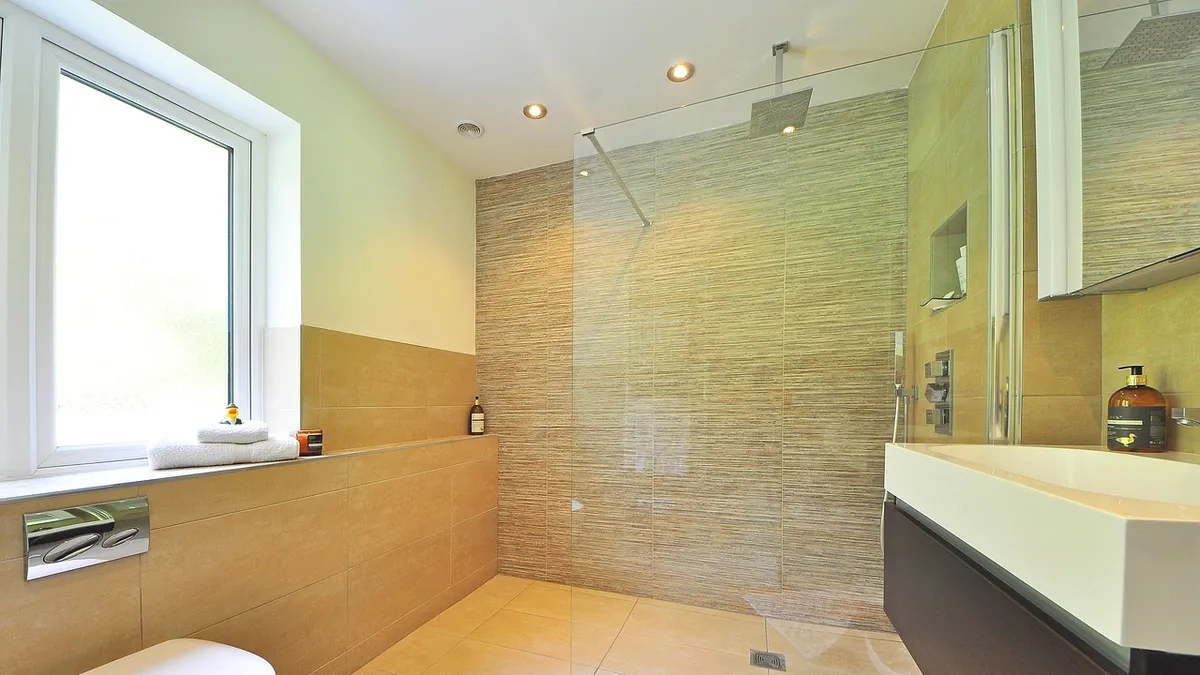
Both 3/8″ (10mm) and 1/2″ (12mm) are tempered safety glass, built to the same federal impact standard (16 CFR 1201) and the related ANSI Z97.1 consensus standard that governs shower and tub enclosure glazing. The difference is purely structural: a frameless panel has no metal frame holding its edges, so the glass itself has to be stiff enough to stay flat and support its own weight (and anyone who leans on it) across the whole opening. A thicker pane resists bowing and flexing over a larger unsupported span, which is why thickness scales with panel size rather than with the brand or finish you choose.
How Much Does Each Thickness Weigh?
Per fabricator reference data, 3/8″ tempered glass weighs about 4.9 lb per square foot, and 1/2″ weighs about 6.5 lb per square foot. On a common 28″ x 76″ door, that works out to roughly 72 lb in 3/8″ glass versus roughly 96 lb in 1/2″ glass — already a 24-pound difference on a standard-size panel.
Go slightly larger, and the gap gets more important. A 30″ x 76″ opening is 15.83 square feet. In 1/2″ glass, that is 15.83 x 6.5 ≈ 103 lb — over 100 pounds on a door barely wider than the standard size. Wider walk-in openings push this further. The hardware chosen for that door has to be rated for its actual weight and width, not just for “frameless glass” in general; see hinges vs. sliding track for how that hardware rating works in practice.
Which Thickness Fits Your Opening, Steam Use and Budget?
Use this table as a starting point, then confirm the exact rating with your installer’s hardware spec sheet:
| Situation | Typical recommendation | Why |
|---|---|---|
| Standard swing door, up to about 84″H x 30″W | 3/8″ | Meets typical unsupported-span guidance; lighter, so standard hinges work |
| Large walk-in panel, up to about 120″H x 36″W | 1/2″ | Extra rigidity needed across the wider unsupported span |
| Steam shower enclosure | Match to panel size, not steam alone | Thickness is a structural choice; steam-tightness instead depends on the door’s seals, sweep and configuration |
| Tight budget, standard-size opening | 3/8″ where it’s structurally adequate | Less glass weight, often standard (less costly) hardware |
| Oversized or custom opening | 1/2″, confirmed with installer | Required once you’re outside standard spans, regardless of budget preference |
Note that a frameless enclosure is “not an aquarium” by design — it is not meant to be fully watertight regardless of thickness, and performance depends on the configuration (door size, return panel, threshold). Getting the exact opening size right before you order glass of either thickness matters, since a custom panel can’t be trimmed down later; see our full measuring guide before you order. For the bigger picture on choosing a setup, start with the frameless shower door guide.
What Does Each Thickness Cost to Buy and Install?
There is no single verified national price list for 3/8″ versus 1/2″ glass — pricing depends on your fabricator, region and the specific panel size. What is consistent is the direction of the cost: 1/2″ glass costs more in raw material, and because it’s heavier it typically needs a heavier-duty (and pricier) hinge or track set. For the full breakdown of what drives frameless pricing beyond the glass itself, see frameless vs. framed shower door cost.
Why Does a 1/2″ Door Topping 100 Pounds Matter?
A door is not just glass — it is glass hanging on hinges or rolling on a track, both rated by the hardware manufacturer for a maximum weight and width. If a panel’s actual weight exceeds what its hardware is rated for, the hinges can sag, pull loose from the wall anchor, or fail outright over time. This is a installation and hardware-selection issue, not a reason to avoid 1/2″ glass — it just means the installer needs to confirm the hardware is rated for the specific door’s calculated weight (width x height in square feet x the per-square-foot weight above), and that the wall anchoring behind it can support that load. Always confirm this with your glass installer rather than assuming any hinge works for any size door.
Because the hinge-to-wall connection is load-bearing once a door passes the 100-lb mark, this is not a project to template or drill yourself. A licensed glass installer can confirm the wall substrate, choose hardware rated for the calculated weight, and set the anchors correctly. The same caution applies later on: if a panel ever gets cracked or chipped, it should go to a professional for replacement rather than a DIY repair, since tempered glass cannot be safely re-drilled or patched once it’s made.
Frequently Asked Questions
Can I just always choose 1/2″ glass to be safe?
You can, but it costs more and needs heavier-rated hardware and wall anchoring even on openings where 3/8″ would have been structurally adequate. Match the thickness to your actual panel size rather than over-building by default.
Does thicker glass look different?
Slightly — 1/2″ glass has a bit more visible edge thickness and can look marginally more substantial, but both thicknesses are clear tempered glass and the visual difference is subtle once installed.
Is 1/2″ glass required for a steam shower?
Not specifically because of steam. Thickness is driven by panel size and structural support, not by steam exposure. A steam enclosure’s seal quality (sweeps, gaskets, configuration) matters more for containing steam than glass thickness does.
How do I know what weight my specific door will be?
Multiply the width and height (in feet) to get square footage, then multiply by about 4.9 lb (3/8″) or 6.5 lb (1/2″) per square foot. Give that number to your installer so they can confirm the hardware and wall anchoring are rated for it.
Can a glass shop re-cut 1/2″ glass down to save weight after it’s tempered?
No. Tempered glass cannot be cut, drilled or ground after tempering without shattering it. Thickness and size must be specified correctly, and the opening measured accurately, before the glass is ordered and tempered.
Sources
- Singular Glass Hardware — Glass Weight Reference
- Glass Magazine (National Glass Association) — “Safe + Beautiful + Frameless”
- U.S. CPSC, 16 CFR Part 1201 — Safety Standard for Architectural Glazing Materials
framelessglassguide.com Editorial Team. Last updated: November 13, 2026.


[…] glass costs more to buy, ship and handle, and that cost shows up directly in a frameless quote. See glass thickness: 3/8″ vs. 1/2″ for the full weight comparison and a worked […]
[…] The two standard thicknesses are 3/8″ (10mm) and 1/2″ (12mm) tempered glass. As a rough guide from glass industry trade sources, 3/8″ suits panels up to about 84″ tall by 30″ wide with an unsupported corner, while panels up to about 120″ tall by 36″ wide need the extra rigidity of 1/2″ glass. The jump in thickness also means a jump in weight: roughly 4.9 lb per square foot for 3/8″ versus about 6.5 lb per square foot for 1/2″ — which matters once you get to hardware. The full breakdown, including a worked weight calculation, is in glass thickness: 3/8″ vs. 1/2″. […]
[…] wear or loosening. A heavy tempered-glass door (see our piece on glass thickness and weight) puts continuous load on its hinges; over years, hardware can loosen and let the door sag slightly […]